Mobile-First Approach: How Gear Code Scaled Fast
Written by Lonocode Team

Background
Gear Code is a startup focused on technical operations and live event logistics. To enter the market, it needed a Minimum Viable Product (MVP) built with a mobile-first approach. The goal was to validate its core value and gain early traction. Gear Code’s vision was to simplify gear labeling, tracking, and management. The platform needed to work across dynamic environments, whether it’s a small venue or a large stadium project.
Lonocode partnered with Gear Code to design and build a mobile-first MVP that would serve as the foundation for a scalable platform. The initial release focused on essential features such as barcode and QR scanning, tag relationships, geolocation, and image attachments. This all needed to be accessible via mobile and desktop interfaces. This lean feature set allowed Gear Code to quickly onboard users, gather feedback, and demonstrate product-market fit without overextending development resources.
The Challenge
Before Gear Code, technicians and operations teams managing complex cable and equipment setups, especially in environments like small venues, touring productions, and large stadium projects, faced four persistent challenges:
Inaccessible environments: Gear is often installed in hard to reach locations. This could be behind racks, under stages, or in ceiling grids, making it impractical to carry a laptop into these areas. Technicians needed a mobile-first solution that could go wherever the gear was.
Fragmented asset tracking: Gear was often tracked using spreadsheets, handwritten notes, or siloed systems. This made it difficult to maintain consistency across teams, projects, and locations.
Manual cable tracing and gear labeling: Without a unified system, technicians had to physically trace cables and manually label gear, often relying on outdated drawings or memory. Under the pressure of live event timelines, this process was time consuming, error prone, and inefficient.
Limited visibility into gear location and status: Teams lacked real-time insight into where gear was located, how it was connected, or whether it was in use. This led to delays, miscommunication, and increased risk of gear loss or misallocation.
These challenges were even harder in fast paced, unpredictable environments. Users needed speed, accuracy, and adaptability. Gear Code solved this by offering a mobile-first, barcode enabled platform that brought clarity and control to gear management.
A Low-Code Solution with a Mobile-First Approach
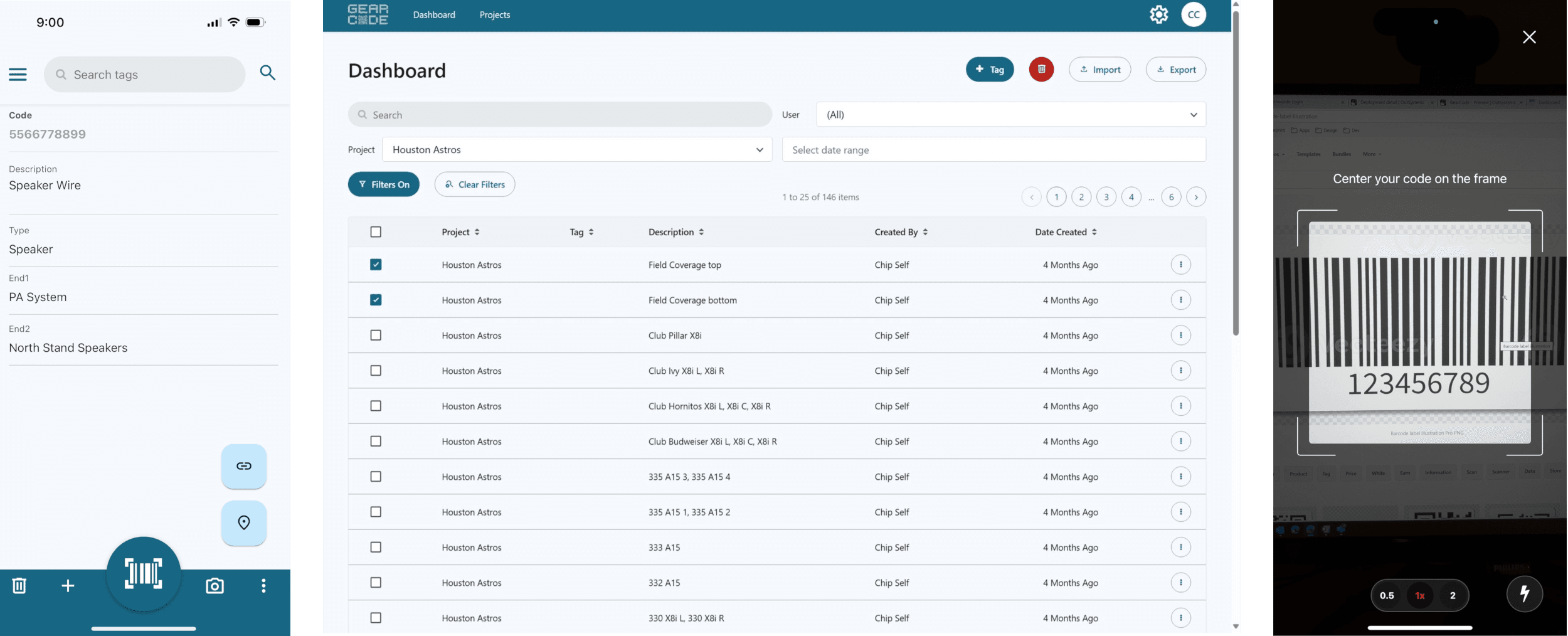
Lonocode built Gear Code from the ground up with a mobile-first approach, recognizing that technicians and operations teams often work in environments where laptops are impractical and speed is essential. Whether crawling under stages, navigating tight rack spaces, or managing gear in sprawling stadiums, users needed a tool that could go wherever the gear was. Gear Code delivered exactly that.
Lonocode’s development approach emphasized rapid delivery and adaptability. By leveraging a low-code platform, the team was able to accelerate the build cycle, reduce overhead, and focus on solving real-world problems. This allowed Gear Code to move from concept to deployment in record time, while maintaining the flexibility to evolve with user feedback and operational demands.
Lonocode developed, deployed and operates Gear Code is fully turnkey SaaS product. Lonocode handles everything from infrastructure and hosting to updates and 24/7 uptime, allowing Gear Code to focus entirely on its users and growth. By building on the OutSystems platform, Lonocode ensures the product remains agile and maintainable, keeping technical debt low while enabling rapid iteration.
By combining mobile-first design with low-code agility, Gear Code positioned itself as a modern answer to legacy asset management challenges. This empowers users to label, track, and manage gear with unprecedented ease and precision.
The Result
Lonocode didn’t just build an app, they built a solution. Their low-code approach meant we could move fast, test ideas, and get to market without the usual delays or budget overruns.
What impressed me most was how turnkey the process was. Lonocode handled development, deployment, and hosting. We didn’t have to worry about infrastructure or maintenance. They made it easy to focus on our users.
Chip Self
CEO, Logic Systems
Solution Highlights
Rapid Development
By leveraging the OutSystems platform, Lonocode delivered Gear Code with speed and flexibility. This reduced development time and kept technical debt low.
Seamless Payments
Gear Code launched with built-in Stripe support, enabling seamless subscription management. Because of this automated billing was enabled from day one.
Fully Managed
Lonocode developed, deployed, and continues to manage Gear Code as a fully hosted SaaS solution, ensuring 24/7 uptime and eliminating infrastructure overhead for the client.
Built for the Field
Designed for technicians in the field, Gear Code works wherever the gear is. This could be under a stage, behind a rack, or in a stadium grid—without the need for a laptop.
Keep Reading
Related Posts

We Have Been Ahead of the Agentic Coding Curve for Almost 4 Years
Everyone is scrambling to figure out agentic coding right now, but honestly, this is a world we already know. We have been living inside low-code platforms for almost four years, and a lot of what people are excited about today is stuff we have already been doing.

From Modernization to Mobility: Lonocode's Strategic Pivot to Mobile-First Low-Code Solutions
At Lonocode, our journey began with a clear mission: to help organizations modernize their legacy systems using low-code platforms. We focused on extending, refactoring, and...

Case Study: How We Built a Low-Code Mobile App for Follow Ministries
Lonocode stepped in with a mobile-first, low-code approach that aligned perfectly with Follow Ministries' needs, going from concept to launch with speed and measurable impact.
Have a project like this in mind?